
Here you’ll find reports, announcements, articles and important documents concerning our finances, our structure and our governance.
Helios: Insurance Returns with Greater Stability
By Jen Tan, Head of Portfolio Strategy
Jen Tan, Head of Portfolio Strategy, Helios Underwriting Plc, shares Helios’s strategy for providing a thoughtfully curated, actively managed portfolio, with greater stability than typically found in high-return opportunities.
In the world of investing, insurance has long been the quiet achiever, but for those with a long-term view, it has often proved one of the most dependable. And within that world, Helios Underwriting offers a particularly elegant proposition: access to the Lloyd’s market through a thoughtfully curated, actively managed portfolio, with greater stability than typically found in high-return opportunities.
Helios is the only publicly listed vehicle providing diversified participation across a broad selection of Lloyd’s syndicates. For 2025, our portfolio comprises 35 syndicates with £491m of capacity. We broadly mirror the Lloyd’s market class mix, but apply deliberate tilts toward syndicates with a proven underwriting track record and disciplined risk management. With only 44% capital required to support its well diversified underwriting exposure (a metric known as ECA per Capacity) in 2025, Helios manages to generate higher returns on capital than many peers who deploy far more.
Return Profile: Narrower Distribution, More Predictable Outcomes
The distinguishing feature of the Helios portfolio is not just its level of return, but the reliability of that return. Figure 1
compares the simulated Return on Capacity distributions for Helios against three representative Lloyd’s syndicates: a Property Catastrophe syndicate, a mono-line startup syndicate, and a composite syndicate. Helios (shown in red) exhibits a notably narrower and more symmetric distribution. This shows that the Helios’ portfolio has
- Lower volatility: returns are more tightly clustered around the mean
- Reduced downside risk: the left hand tail (negative Return on Capacity) is materially thinner than that of the Property Catastrophe syndicate
- Limited exposure to extreme outcomes: both negative and positive extremes are less likely, reflecting a portfolio optimised for stability.
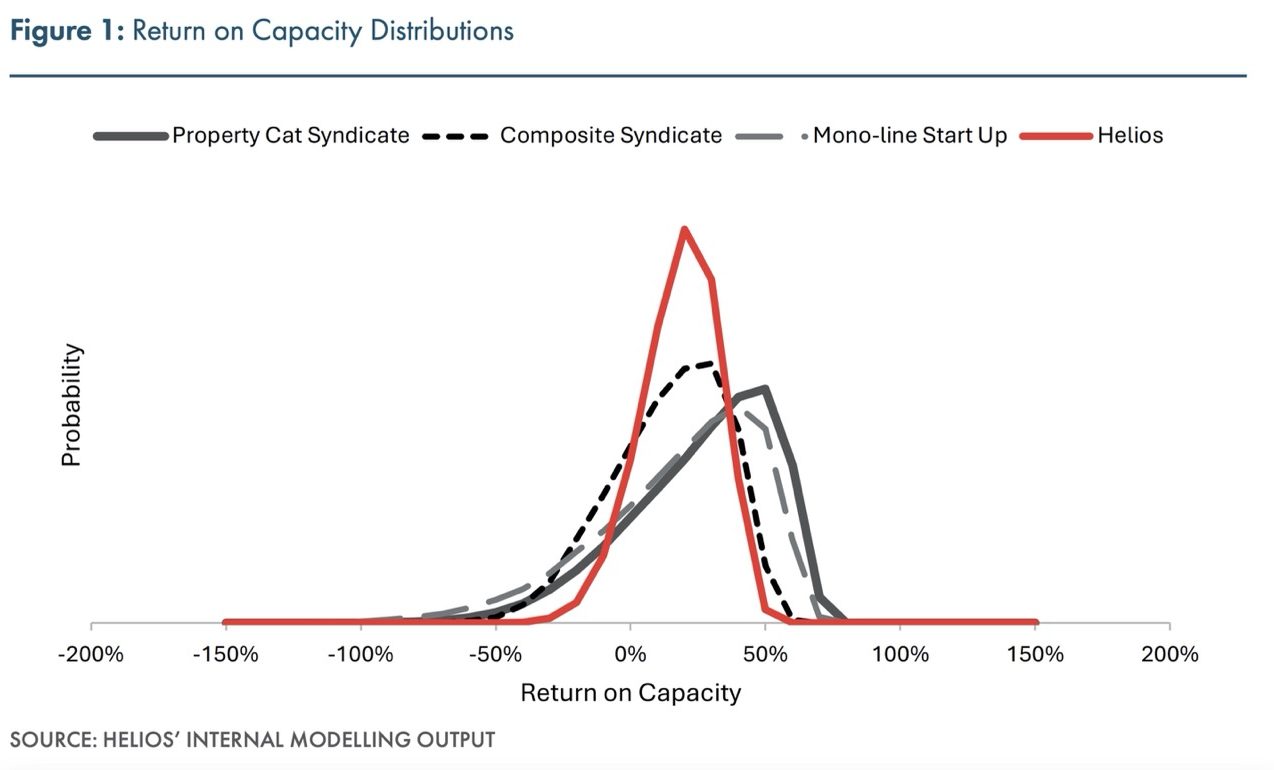
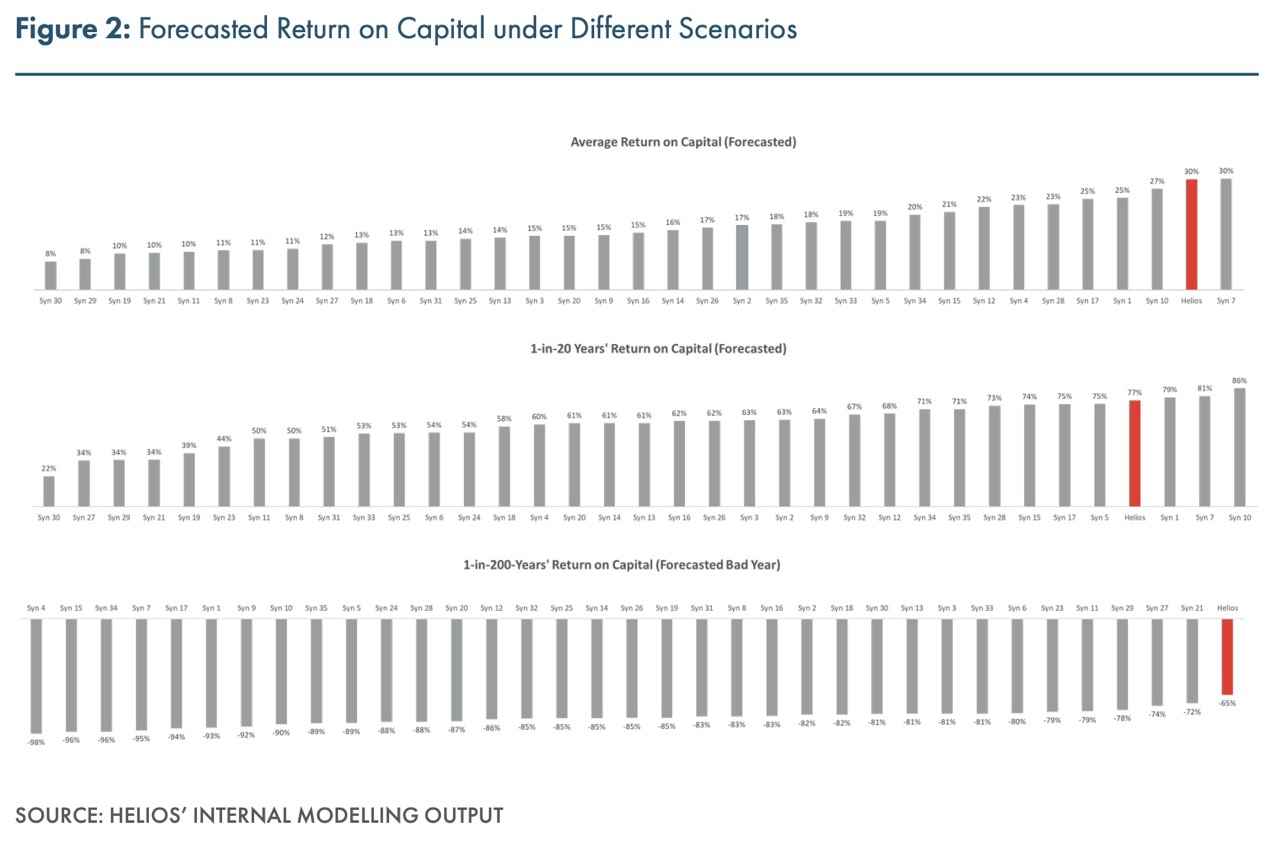
While individual syndicates show broader distributions with heavier tails, indicating greater uncertainty, the Helios portfolio demonstrates a high level of predictability. With its low capital requirement, Helios is forecasted to deliver superior Return on Capital, significantly outperforming individual syndicates. Figure 2 shows modelled Return on Capital projections for individual syndicates and for the Helios portfolio, based on 2025 rating levels. These results are illustrative and would naturally evolve through the cycle as pricing, capital requirements, and exposure mixes change.
The top chart shows the average Return on Capital across scenarios. The Helios portfolio is forecasted to outperform all individual syndicates in Helios’ portfolio except for one Property Catastrophe syndicate, driven by its diversified structure and relatively efficient use of capital.
The middle and lower charts show estimated results in tail scenarios. The 1-in-20-year result refers to the top 5% of outcomes which indicates the upside potential in more favourable conditions. The 1-in-200-year result, by contrast, captures the bottom 0.5%. Helios is projected to perform well in all scenarios. Its 1-in-20 Return on Capital reaches 77%. In the 1-in200 scenario, the Helios portfolio shows the lowest losses on capital (–65%). This demonstrates the diversification benefit of Helios’ diverse exposure across syndicates and classes. These results are based on a stochastic model using syndicates’ 2025 projected loss ratios and ECAs to calibrate the statistical distribution of the returns. While the framework provides a useful guide to expected performance and tail risk, results remain subject to underlying assumptions and prevailing market conditions.
Balanced by Design
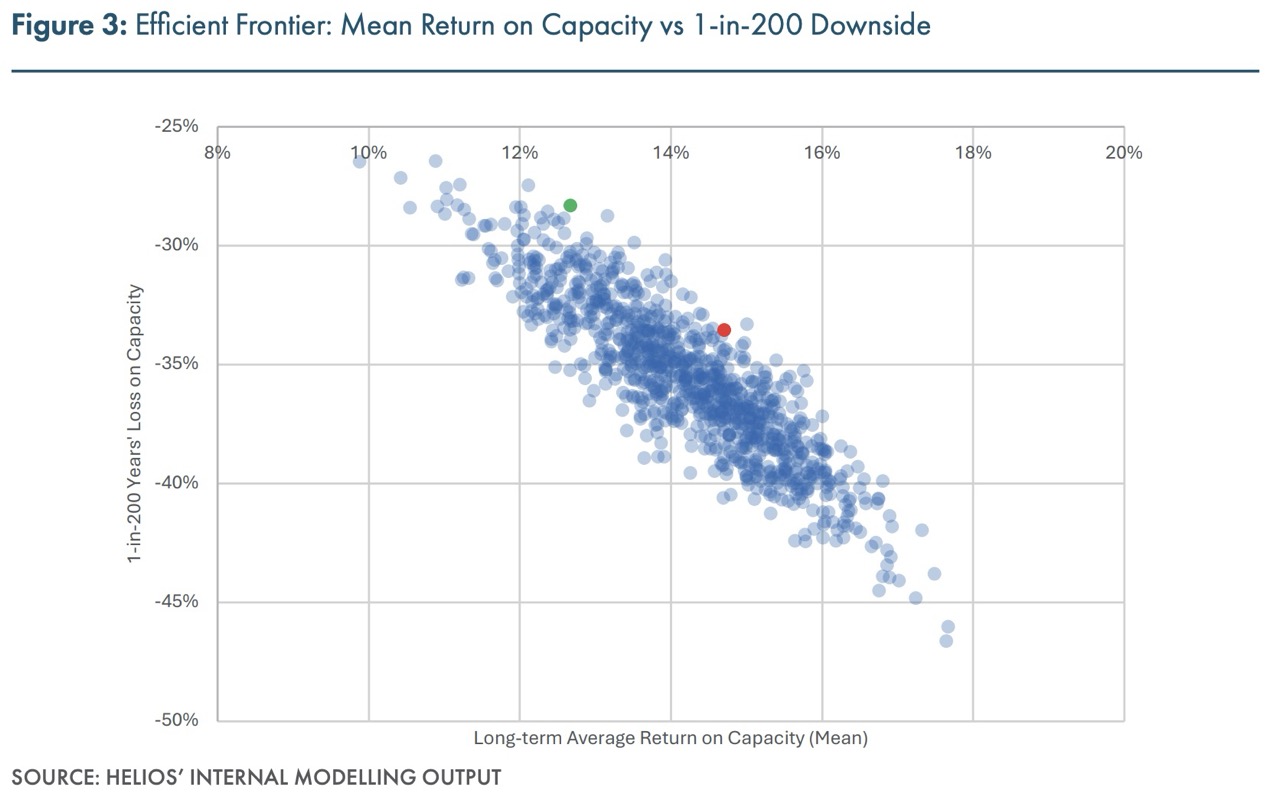
Insurance returns are not linear. Some years are strong and others, hit by hurricanes or inflation shocks, are not. That is why Helios uses a risk-and-return framework inspired by institutional finance: the Efficient Frontier. Rather than rely on intuition or backward looking averages, we model 100,000 scenarios per syndicate and combine them based on correlation and volatility profiles.
Our goal is to identify a mix of syndicates that maximises return for a given level of risk, and to minimise drawdown in the most adverse years. In figure 3, each dot on the chart represents a different combination of capacity allocations across the syndicates in our model. The Efficient Frontier (the downward sloping edge of the cloud) marks the portfolios that offer the best possible balance between return and extreme downside. Any move beyond that line requires either accepting lower returns or taking on higher level of risk. In this example, the current portfolio, shown in green, already sits on this frontier. However, the modelling also shows room for further refinement. By rebalancing allocations to reduce the projected 1-in-200-year downside from –28% to –34% of capacity, we can lift the average return on capacity from 13% to 15%, while remaining on the frontier. Optimisation, however, must be shaped by the investor’s broader commercial objectives and tolerance for risk. Whether the focus is on protecting capital or increasing expected returns, the Efficient Frontier offers a clear framework for evaluating trade-offs and aligning the portfolio with strategic goals.
Conclusion
The Helios portfolio is built to deliver attractive, repeatable returns through a capital-efficient, risk-aware investment process. With uncorrelated exposures, a tighter return profile, and an actively managed portfolio, we believe Helios offers a credible and differentiated route to Lloyd’s participation. Access to the Helios portfolio is available through Members’ Agent Pooling Arrangements (MAPAs), as well as via reinsurance by third party capital providers. For new entrants, ‘Starter Homes’ offer a simplified route to lease capacity in selected leading syndicates, providing a flexible entry point into the market. The Efficient Frontier shows the trade-offs between return and downside exposure, but it is only one input into the capacity allocation process. Our data driven analytics complements our direct engagement with syndicates, our understanding of the market, and the expert judgement of an experienced team and Board. It is this integration of modelling and judgement that characterises the Helios strategy and informs our allocation of capital within the Lloyd’s market.